What Is Perfect Bound Book Printing?
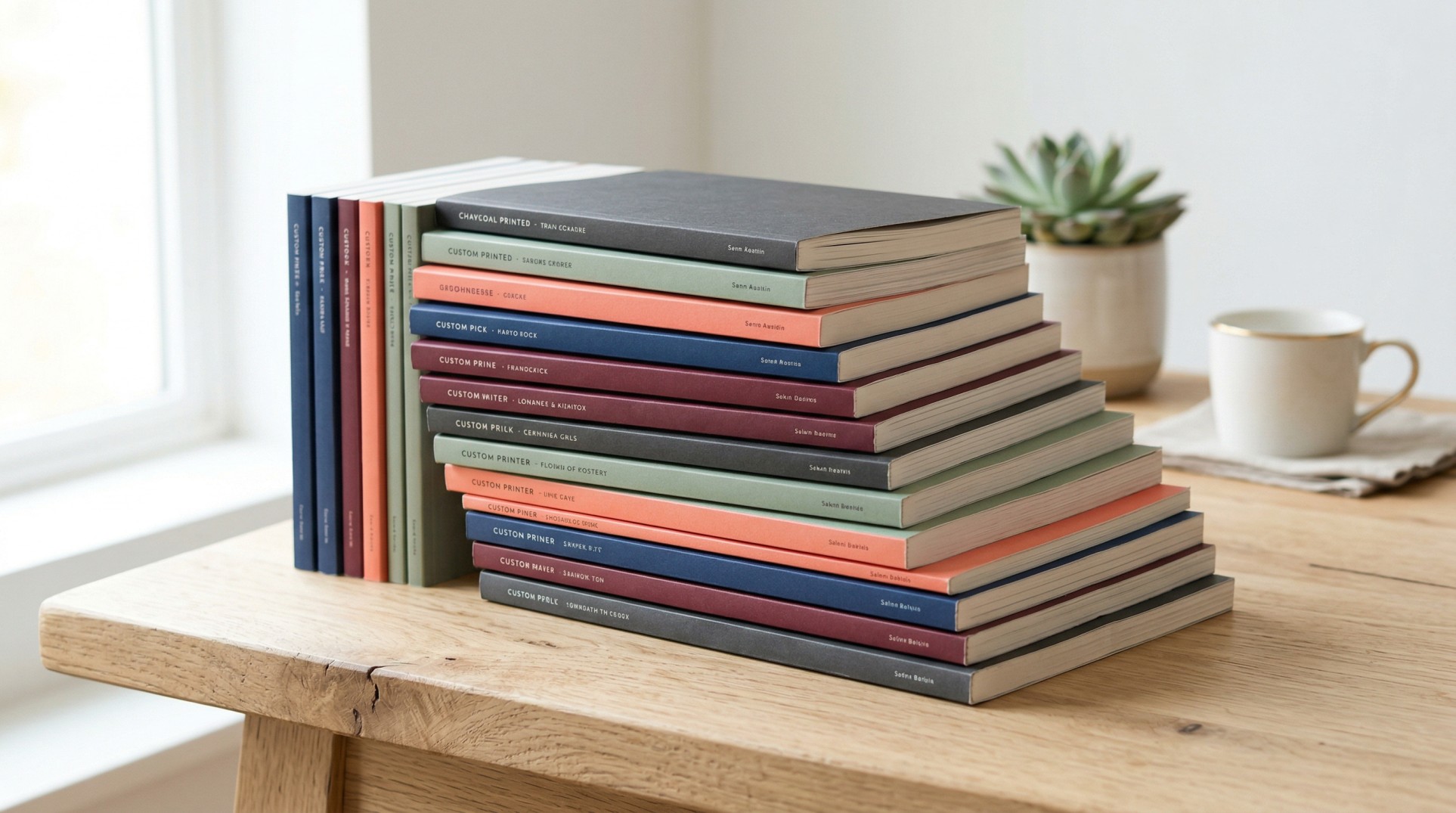
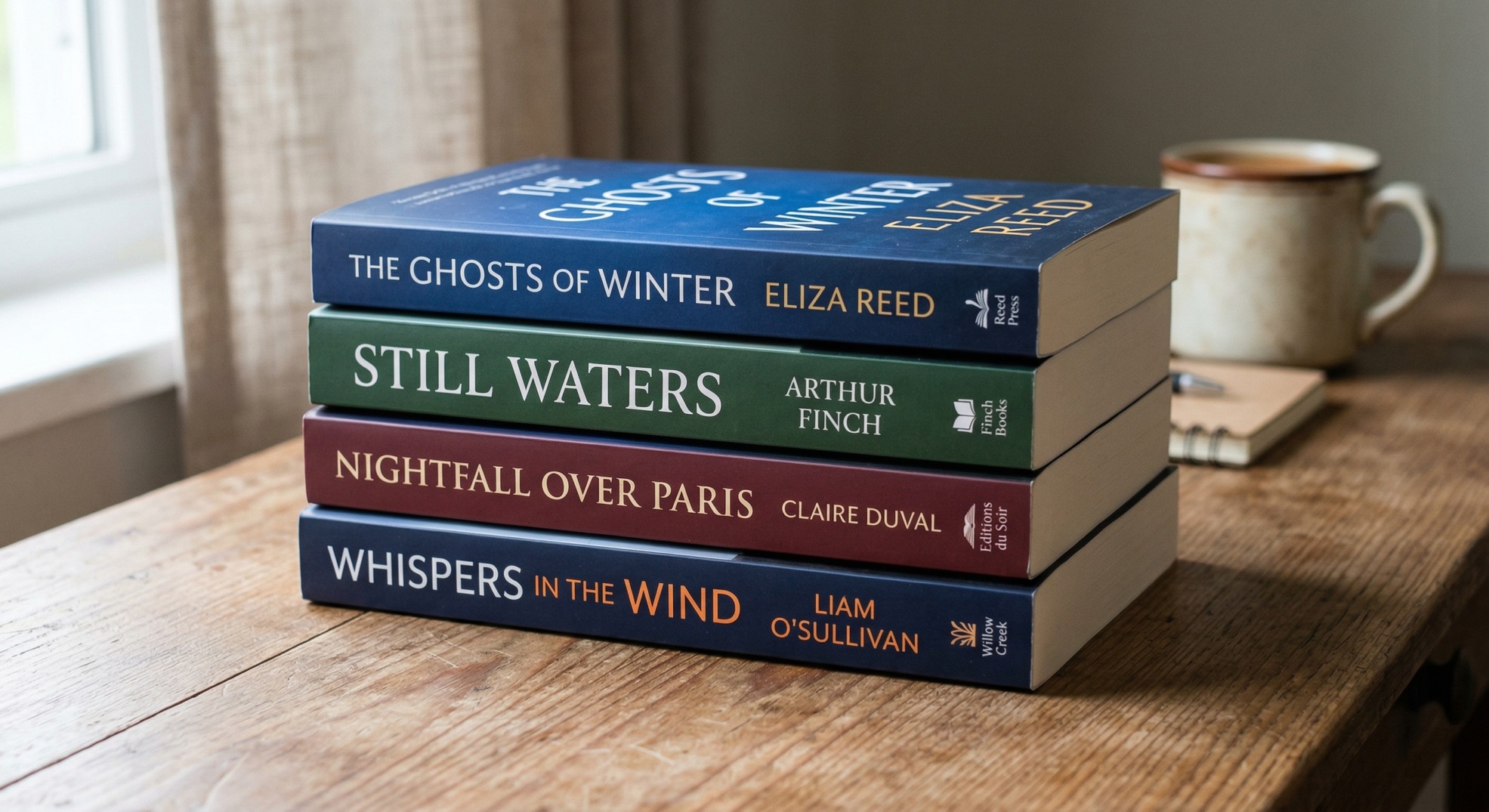
Perfect bound book printing is the flat-spine paperback binding style you see on almost every trade paperback novel, memoir, and non-fiction book sold in stores. The interior pages are gathered, the folded edge is roughed up, and a strong PUR adhesive is applied to the spine before the printed cover is wrapped around the block and trimmed flush on three sides.
The result is a clean, square spine that you can print a title and author name on - the hallmark of a professionally produced paperback. Perfect binding feels substantial in the hand, stacks neatly on a shelf, and reads like any mass-market paperback you'd buy at a bookstore.
Because the spine is glued, the width of the spine grows with the page count. A 100-page book has a thin spine; a 500-page novel has a substantial one. Our calculator handles the spine width automatically when you set up your custom paperback.
Perfect Binding, Perfect Bound, or Soft Cover - What's the Difference?
If you've searched for "perfect binding," "perfect bound book printing," "soft cover book binding," or "PUR bound books," you've been looking at the same binding method with different terminology. Here's how the terms break down:
- • Perfect binding is the formal name for the process - page edges roughed up, PUR adhesive applied to the spine, printed cover wrapped around and trimmed. This is the core industry term.
- • Perfect bound is the adjective describing the finished book ("a perfect bound paperback"). Used interchangeably with "perfect binding."
- • Soft cover (or softcover) is the consumer-facing term. When readers say "I prefer softcover to hardcover," they mean the same thing as perfect bound. Most consumers don't know "perfect binding" but they all know "soft cover."
- • PUR bound refers specifically to the adhesive type used. PUR (polyurethane reactive) is the premium glue that bonds stronger and handles temperature swings better than older EVA (ethylene vinyl acetate) glues. Every perfect bound book we print uses PUR adhesive.
- • Paperback is the retail/shelf term. Every mass-market paperback at a bookstore is perfect bound. The words "paperback" and "perfect bound" describe the same book from two angles: paperback describes the cover (soft paper), perfect bound describes the binding (glued spine).
At YourBookPress, ordering perfect binding is the same as ordering perfect bound book printing is the same as ordering soft cover book printing is the same as ordering PUR bound books. One service, one process, one finished paperback - just different words depending on what term you searched.
Best Uses for Perfect Binding
Perfect binding is the default choice for any book you want to look and feel like a retail paperback. It's the right fit for:
- Soft cover novels and memoirs - the trade paperback standard every reader recognizes.
- Poetry collections and short story anthologies.
- Business books, guides, and training manuals.
- Self-published titles sold on Amazon, at events, or direct to readers.
It's by far the most popular choice for self-published authors because it hits the sweet spot between cost, durability, and a professional trade-paperback presentation. For fiction in particular, novel printing almost always means perfect binding. If you already have a finished PDF, see our print a book from PDF guide for the step-by-step process.
Perfect Bound Booklets, Catalogs, and Brochures
Perfect binding isn't just for books - it's widely used for anything that needs a bookstore-quality flat spine. Three applications beyond traditional books:
Perfect Bound Booklets (48-200 pages)
A perfect binding booklet bridges the gap between stapled saddle stitch booklets (limited to 80 pages) and full-length books. Common uses: annual reports, extended program booklets for multi-day events, corporate overviews, product manuals, literary magazines with substantial page counts, and limited-edition zines at higher page counts. When people search "bound booklet" or "perfect binding booklet," this is what they usually want - a softcover publication too thick for staples but presented as a booklet rather than a book.
Perfect Bound Catalog Printing
Product catalogs, wholesale lookbooks, and retail catalogs benefit from perfect binding when page counts exceed 64 pages. A perfect bound catalog stacks cleanly on a shelf, has a printable spine for identification, and gives the catalog a retail-product feel rather than a promotional-mailer feel. Common in wholesale trade, furniture retail, art galleries, and B2B sales organizations. For catalog printing perfect binding projects, the standard specs are 8.5"x11" letter size, 100# glossy paper for product photography, and full color throughout.
Perfect Bound Brochures
At 64+ pages, brochures transition into "booklet" territory where perfect binding makes more sense than saddle stitch. Common for luxury real estate developments, destination travel marketing, university viewbooks, and high-end service offerings where the brochure is itself a premium deliverable. Perfect bound brochure printing typically uses premium cover stock with matte lamination for a substantial, gift-worthy feel.
For thinner publications under 64 pages - programs, event booklets, short zines, small catalogs - saddle stitch binding is more appropriate.
Perfect Bound Specifications
Our perfect binding accepts page counts from 64 pages up to around 800 pages. Below 64 the spine is too thin to hold adhesive reliably - for shorter publications you'll want saddle stitch book printing instead.
All 11 of our trim sizes work with perfect binding, from 4.25" x 6.23" pocket up through 8.5" x 11" letter. The most common sizes for fiction are 5.5" x 8.5" digest and 6" x 9" US trade - both ship as a true trade paperback printing format that fits standard retail shelves.
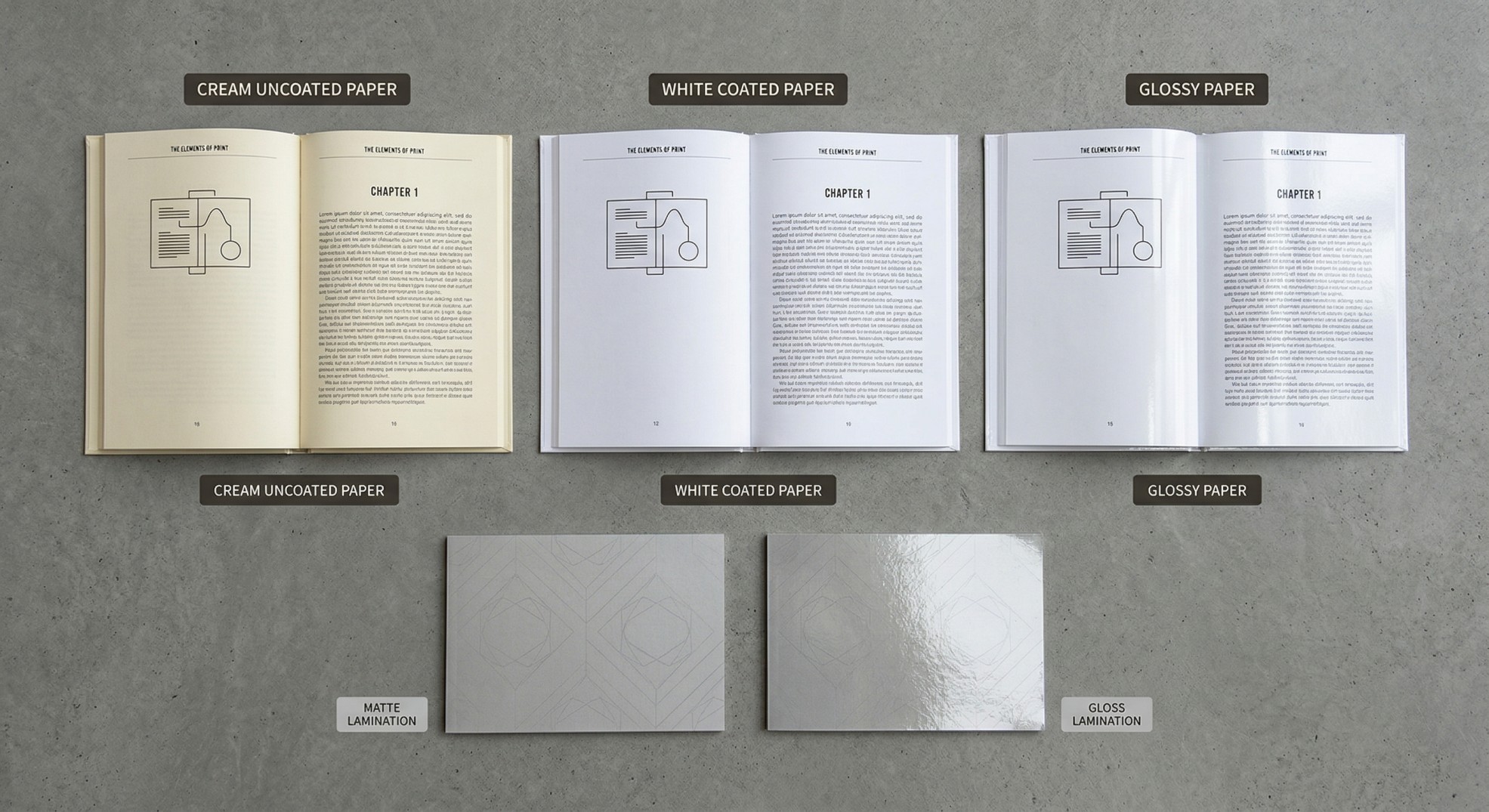
Interior paper is where the feel of your book gets decided. 70# uncoated is the go-to for novels because it reads like a bookstore paperback. 80# coated is smoother and better for books with photos or illustrations, and 100# glossy is reserved for photo-heavy or art titles. Covers are printed on heavy card stock in full color, with your choice of matte or gloss lamination. Not sure which to pick? Learn how to choose the right paper weight for your book.
PUR Perfect Binding - Why Our Adhesive Matters
Not all perfect binding is created equal. The adhesive determines whether your book holds up for years or cracks open after a few reads.
PUR (Polyurethane Reactive) Adhesive - What We Use
PUR is the premium adhesive for perfect binding. It creates a stronger bond than traditional EVA glues, remains flexible across temperature ranges (important for books that ship in cold or hot weather), handles coated and specialty papers that EVA can't bond to, and allows the book to open flatter without cracking the spine. Books bound with PUR pass the "open and hold" test - you can open them wide without the glue failing.
EVA (Ethylene Vinyl Acetate) - What Cheap Printers Use
EVA is the cheaper adhesive used by budget printers and office copy shops. It bonds quickly and works fine for short-term use publications, but it doesn't handle temperature variation well, struggles with coated paper, and the spine tends to crack when books are opened wide. You can usually spot EVA-bound books because they don't lay flat and the spine shows creasing after normal reading.
Every perfect bound book printed at YourBookPress uses PUR adhesive. This isn't an upcharge or a premium option - it's our standard. When you order perfect binding from us, you're ordering PUR perfect bound construction by default.
Perfect Bound vs Other Binding Types
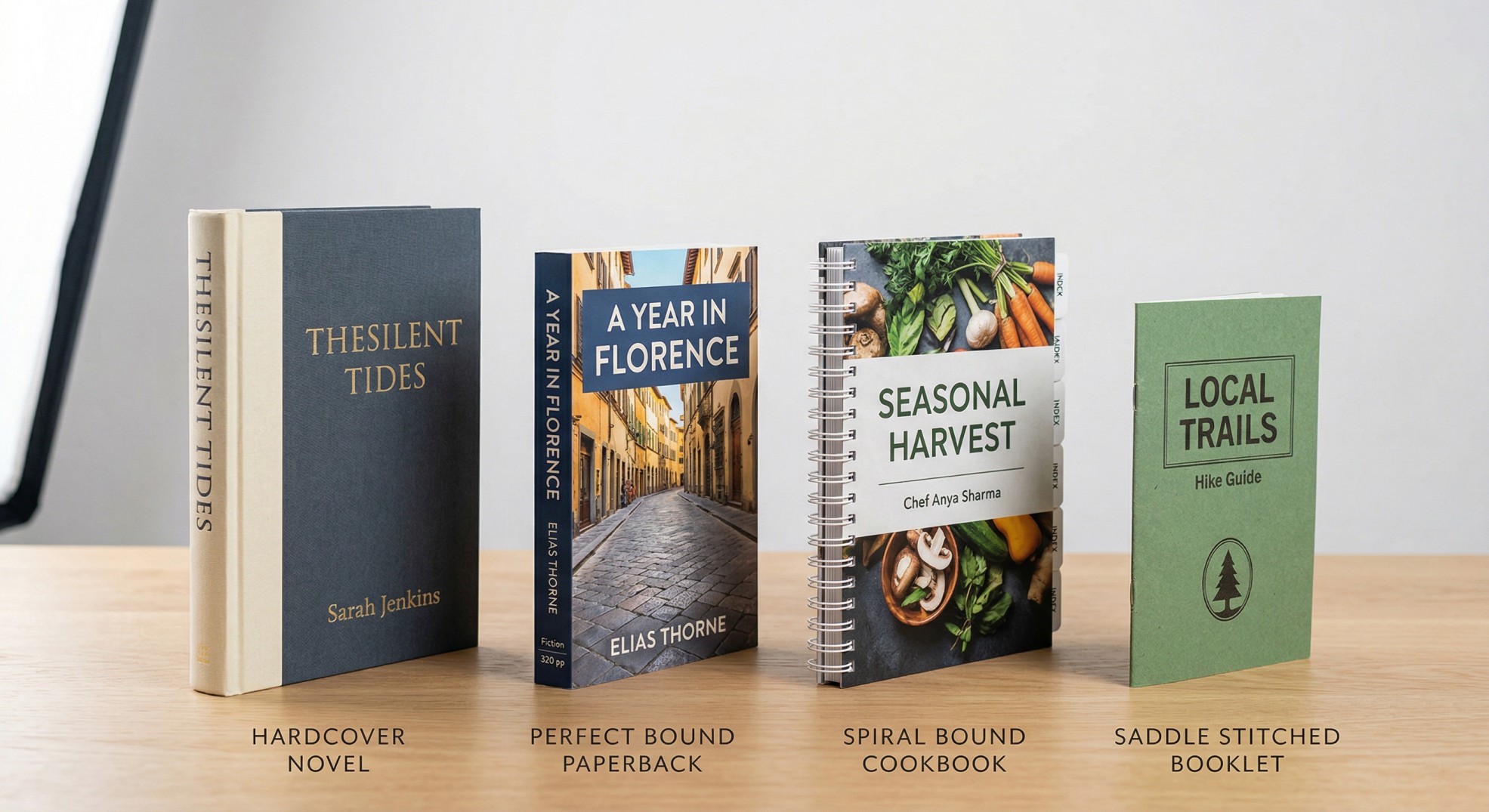
Perfect binding is the default paperback style, but it's not the only option. Here's how it stacks up:
-
Hardcover - more durable and premium than perfect binding, with a rigid case and printed dust jacket or wrap. Costs noticeably more per copy, which is why most self-publishers start with perfect bound and add a hardcover edition once they have demand.
-
Spiral bound - opens completely flat, which is a big deal for cookbooks, workbooks, music books, and manuals. The tradeoff is that a coil binding doesn't read as a "real book" on a retail shelf - spiral is a working-document format, perfect bound is a retail format.
-
Saddle stitch - two staples through the spine fold. It's the cheapest binding and perfect for booklets, programs, chapbooks, and zines, but it caps out around 64 pages. Anything thicker has to move to perfect bound.
If you're still deciding, the rule of thumb is simple: if it's a book people will read cover to cover and put on a shelf, use perfect binding.
Perfect Binding Near Me - Why Online Beats Local Print Shops
If you've searched for "perfect binding near me" or "perfect bound book printing near me," you've probably seen results for Kinko's (FedEx Office), Staples, Office Depot, or local print shops. Here's the honest comparison.
Local print shops (Kinko's perfect binding, Staples perfect binding, etc.)
Convenient for one-off copies in a rush. Limited trim size options (usually letter and legal only). Higher per-copy cost - typically 3-5x online rates. EVA glue rather than premium PUR in most cases. Limited paper stock options. No built-in cover designer. Same-day turnaround is the main advantage.
Online perfect binding services (us)
No minimums, instant pricing, all 11 trim sizes, PUR adhesive standard, professional paper options, built-in cover designer, volume discounts automatically applied, ships to your door. Turnaround is 5-7 days production + 2-5 days shipping - longer than local same-day but competitive on 48-72 hour rush production.
The breakeven math: for 1 copy in 24 hours, a local shop may make sense. For anything beyond that - 5 copies, 25 copies, 200 copies - online perfect binding services win on price, quality, and paper selection. Most people searching "perfect binding services near me" save 40-70% by ordering online instead.
Perfect Bound Book Printing Pricing
Perfect binding pricing depends on four things: page count, paper type, interior color (B&W vs color), and quantity. As a rough benchmark, a 200-page 6" x 9" B&W soft cover book starts around $5.80 per copy for a single book and drops to around $2.15 per copy at 1,000 copies - a 60%+ volume discount.
For wholesale perfect bound book printing - retail inventory, bulk author launches, bookstore distribution, or large educational runs - the per-copy cost drops steeply as quantity goes up. Larger perfect bound books printing orders of 500 or more copies unlock our best pricing tiers, and there's no upper limit: we handle runs well into the thousands.
The easiest way to get an exact number is the calculator at the top of this page. For a more detailed breakdown of how each spec affects price, see our book printing cost guide.
Perfect binding cost depends on what you're printing. A 200-page novel runs ~$5.80-$2.15 per copy as shown above. A 48-page perfect bound booklet might run $3-5 per copy at small quantities. A 120-page perfect bound catalog with full color and 100# glossy paper runs $8-12 per copy at 50 copies. The calculator shows exact pricing for your configuration.
Looking for cheap perfect binding? Order 50+ copies to unlock volume discounts. Choose B&W interior over color (saves 40-60%). Use 70# uncoated paper instead of coated. Stick with standard trim sizes (6"x9" US Trade is the most cost-efficient). This combination gives you the lowest perfect binding price per copy in our catalog while keeping full professional quality.
Setting Up Perfect Binding in InDesign, Word & Other Software
One common question: how do I set up my file for perfect binding? The short answer - create a PDF at your final trim size with proper bleed and margins.
Perfect Binding in Adobe InDesign
Create a new document at your selected trim size (e.g., 6"x9"), add 0.125" bleed on all sides, and set inside margins to 0.75" (perfect bound books need wider inside margins because the glue spine takes some of the inside page space near the gutter). Export as PDF/X-1a or PDF/X-4 with "Include Bleed Settings from Document" checked.
Perfect Binding in Microsoft Word
Set your page size to your trim size under Layout > Size > More Paper Sizes. Use mirror margins with gutter margin set to 0.25". Export as PDF with "Standard (publishing online and printing)" quality.
Perfect Binding in Canva
Canva's Book Template defaults work for perfect binding. Ensure your template matches your chosen trim size and download as PDF Print with bleed and crop marks enabled.
Other software (Affinity Publisher, Apple Pages, LaTeX, Scrivener): any software that can export a print-ready PDF at your trim size with 0.125" bleed works for perfect binding. Once your file is ready, upload it to the calculator above. The system auto-checks for resolution, bleed, color mode, and font embedding.
What Authors Say
"Ordered 150 copies of my novel in 6x9 soft cover and the spines came out flawless. The cream uncoated paper feels exactly like a bookstore paperback - readers can't tell it's self-published."
Marisa Reyes
Author, The Salt Road
"Did a test run of 10 copies first, then came back a month later for 500. Price per copy dropped dramatically at volume and the quality was identical. No surprises."
Derek Kwon
Indie publisher, Kestrel Press
"I shopped three printers for my 380-page memoir. YourBookPress was the only one that quoted instantly without a back-and-forth email thread. Books arrived in 9 days and the matte cover is gorgeous."
Ana Petrova
Author, What the River Kept
Frequently Asked Questions
What is the minimum page count for perfect binding?
64 pages minimum. Below that, the spine is too thin for glue binding. For thinner publications, saddle stitch is recommended.
Can perfect bound books have full color interiors?
Yes, we offer Standard Color, Premium Color, and B&W options. Full color increases per-page cost but is ideal for textbooks, guides, and photo-heavy books.
How durable is perfect binding?
Professional quality adhesive binding that holds up well for years with normal handling. For maximum durability or premium presentation, consider hardcover binding.
What trim sizes work with perfect binding?
All 11 of our trim sizes support perfect binding, from 4.25" x 6.23" pocket to 11" x 8.5" tabloid landscape.
Is there perfect bound book printing near me?
You don't need a local print shop - we print perfect bound book orders online for customers anywhere in the United States. Orders ship directly to your door with fast turnaround, and quality is consistent whether you're in a small town or a major city. Most authors find online ordering quicker and cheaper than searching for a local shop offering perfect bound book printing near me.
Can I order just one perfect bound book?
Yes, no minimums. Many authors order a single proof copy first before placing a larger order. If you're new to the process, our printing guides on the blog walk through what to expect.
How do I print a PDF like a book?
How to print PDF like a book: upload your print-ready PDF to the calculator above, pick a trim size (we'll verify your PDF matches), choose paper and binding, and approve the proof. We handle the rest - printing, binding, trimming, and shipping. Your PDF should include 0.125" bleed on all sides and be in CMYK color mode for best results.
How long does it take to print a book?
Standard production takes 5-7 business days from proof approval for perfect bound books, plus ground shipping (2-5 business days in the continental US). Rush production (2-3 business days) is available at checkout. Larger runs of 500+ copies can add a couple of days to production. So from upload to your door, most orders arrive in roughly 10-14 days.
How do I print a comic book?
How to print a comic book depends on length. For single-issue floppies under 48 pages, saddle stitch with a glossy cover is the industry standard. For trade paperbacks and graphic novels 64+ pages, perfect bound is the right choice - pick 6.625" x 10.25" or 7" x 10" trim, standard color interior on 80# coated paper, and a glossy or matte laminated cover. Upload your print-ready PDF with bleed and we'll handle the rest.
How do I print a coffee table book?
How to print a coffee table book: choose a large trim (8.5" x 11" letter or bigger), 100# glossy paper for full-color photo reproduction, and premium color interior. Hardcover binding is the classic coffee table book choice for durability and premium presentation, but perfect bound with a heavy matte-laminated cover is a more affordable option that still looks bookstore-quality.
How do I print a board book?
How to print a board book: traditional board books use thick laminated paperboard pages and require specialized board-book manufacturing rather than standard offset or digital printing. For small-run children's books that mimic the board book feel without the minimum order volume, most self-publishers choose a perfect bound or hardcover 8" x 8" square book on 100# glossy paper with a laminated cover - it's thinner than a true board book but durable enough for kids, and can be ordered as a single proof copy.
Is perfect binding the same as perfect bound?
Yes. "Perfect binding" is the name of the process (what the bindery does); "perfect bound" is the adjective describing the finished book (a perfect bound paperback). Same thing, different grammar.
What is the difference between perfect binding and soft cover?
They describe the same book from different angles. "Perfect binding" refers to how the pages are bound (glued to the spine); "soft cover" refers to what the cover is made of (soft paper rather than rigid board). Every soft cover paperback you see at a bookstore is perfect bound.
What is PUR bound?
PUR bound books are perfect bound books using PUR (polyurethane reactive) adhesive rather than older EVA glue. PUR bonds stronger, lasts longer, and allows the book to open flatter without cracking the spine. Every perfect bound book we print uses PUR adhesive as standard.
Can perfect binding be used for booklets?
Yes. Perfect binding booklets are common for publications between 48 and 200 pages that are too thick for saddle stitch but don't need to be called a "book." Common examples: annual reports, extended event programs, literary magazines, corporate overviews.
What is the maximum page count for perfect binding?
Around 800 pages. Below 64 pages the spine is too thin for glue binding (use saddle stitch instead). Above 800 pages the book becomes difficult to handle and hardcover is usually a better format.
Can you do perfect bound catalog or brochure printing?
Yes. Perfect binding works equally well for catalogs, brochures, lookbooks, and marketing publications. The process is identical to book printing. Upload your PDF, choose trim size and paper, order. Most perfect bound catalogs use 8.5"x11" letter size with 100# glossy paper and full color.
How much does perfect binding cost?
A 200-page B&W paperback starts around $5.80 per copy at quantity 1 and drops to $2.15 at 1,000+ copies. Use the calculator above for exact perfect binding prices on your specs.
What's the best software for setting up perfect binding files?
Adobe InDesign is the industry standard for professional book layout. Microsoft Word, Canva, Affinity Publisher, and Apple Pages all work well for simpler projects. Any software that exports a print-ready PDF at your trim size with 0.125" bleed produces a file suitable for perfect binding.