A printed portfolio book is the physical version of your best work - curated, sequenced, and bound into a book that makes an impression the moment someone picks it up. Architects carry them into interviews. Graphic designers leave them with agencies. Photographers sell them at gallery shows. Fine artists send them to residency panels. In every case, the goal is the same: show your work at its absolute best on paper that does it justice.
This guide covers portfolio book printing from start to finish - costs, sizes, paper and binding choices, file preparation, and discipline-specific recommendations for architecture, graphic design, photography, and art portfolios. The calculator at the top gives you an exact price for your configuration in seconds.
What Is Portfolio Book Printing?
Portfolio book printing is custom book printing optimized for showcasing creative and professional work. Unlike a standard novel or text-heavy book, a printed portfolio book is image-forward - the paper, color reproduction, and binding all need to serve visual content at a professional level.
Three things separate a portfolio book from other types of printed books:
- Color accuracy matters. Renders, photographs, and design work need to look on paper the way they looked on your calibrated monitor. Premium color printing with managed color profiles is essential, not optional.
- Paper weight signals quality. A portfolio printed on thin, flimsy paper undermines the work inside it. Coated stock in the 80# to 100# range gives the right heft and print quality.
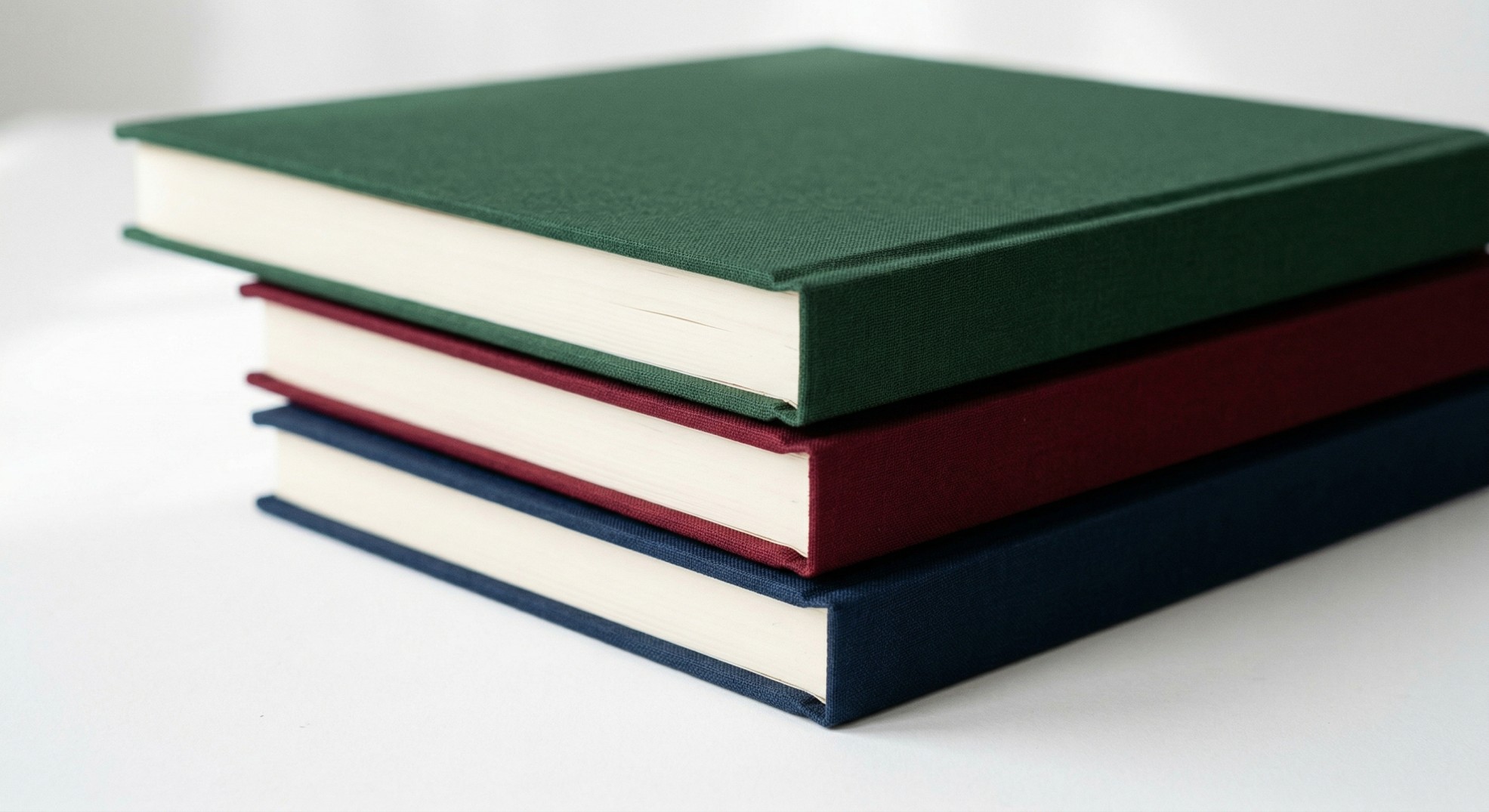
- The binding reflects your professionalism. A perfect bound spine looks clean and intentional. A hardcover says premium. A spiral lets spreads lay flat for presentations. The right binding depends on how the portfolio will be used.
Whether you need a single copy for a job interview or a short run of custom printed portfolio books for a graduating class, the process is the same: design your layout, export a print-ready PDF, configure your specs, and order.
Who Prints Portfolio Books?
The range of professionals and creatives who print portfolio books is wide. What they share is the need for a physical object that represents their work at a level that screens alone cannot.
- Architects - architecture portfolio book printing is one of the most common use cases. Firms expect physical portfolios in interviews, and a well-printed book of project renders, plans, and photography signals the kind of attention to craft that architecture demands.
- Graphic designers - a graphic design portfolio printed book is itself a design piece. The layout, typography, paper choice, and binding all demonstrate your skills before anyone even looks at the projects inside.
- Photographers - photography portfolio book printing puts your images on paper where color, contrast, and detail can be evaluated properly. Gallery submissions, client meetings, and portfolio reviews all benefit from a physical book. If you shoot weddings, our wedding album printing covers client albums, parent copies, and studio samples.
- Fine artists and illustrators - an art portfolio book print compiles paintings, drawings, mixed media, or digital illustrations into a bound catalog for residency applications, gallery pitches, and collector outreach.
- Fashion and models - modeling portfolio books and comp card collections need accurate skin tones, sharp detail, and durable binding that holds up to repeated handling by casting directors and agencies.
- Interior and industrial designers - project documentation, material boards, and concept presentations printed as a bound book make a stronger impression than loose prints or digital slideshows.
- Design students - graduating students print portfolio books for thesis reviews, job fairs, and interview rounds. Many programs require or strongly encourage a printed portfolio as part of the final year.
Portfolio Book Printing Costs
Portfolio book printing costs depend on four main variables: page count, trim size, paper and color mode, and quantity. Because portfolios are typically shorter than full-length books (40-80 pages is the sweet spot), per-copy costs are moderate even at low quantities.
Here's a realistic benchmark for a 60-page 8.5" x 11" perfect bound portfolio with premium color interior on 80# coated paper and a glossy laminated cover:
| Quantity | Per copy | You save |
|---|---|---|
| 1 copy (proof) | ~$12-16 | - |
| 15 copies | ~$9-12 | ~25% |
| 50 copies | ~$7-9 | ~40% |
| 150 copies | ~$5-7 | ~55% |
| 500+ copies | ~$4-6 | ~65% |
Upgrading to hardcover adds roughly 30-50% to the per-copy cost but gives you a rigid, durable book that makes a premium impression. Spiral binding costs slightly more than perfect bound but lets the book lay completely flat - a real advantage for architecture portfolios and large-format design spreads.
The calculator at the top of this page gives you the exact number for your configuration. Swap binding, paper, and quantity to see how each decision moves the price.
Portfolio Book Sizes and Formats
The right size for your custom portfolio book printing project depends on your discipline and how the book will be used. Here are the most common formats:
| Format | Dimensions | Best for |
|---|---|---|
| Letter Portrait | 8.5" x 11" | Most popular - graphic design, architecture, art |
| Tabloid Landscape | 11" x 8.5" | Photography, landscape architecture, wide spreads |
| Executive | 7" x 10" | Compact portfolios, illustration, leave-behinds |
| Mini Landscape | 9" x 7" | Compact photo portfolios, modeling comp books |
| US Trade | 6" x 9" | Text-heavy portfolios, writing samples, case studies |
8.5" x 11" portrait is the default recommendation for most portfolio types. It's large enough to show work at a professional scale, fits standard bags and mailers, and is the format reviewers and interviewers expect. Landscape orientation (11" x 8.5") is the better choice for photography portfolios and architectural projects with predominantly horizontal compositions.
If you're looking for 11x17 portfolio book printing or A3 portfolio book printing, note that standard digital book printing uses trim sizes up to 11" x 8.5" (tabloid landscape). For truly oversized portfolios, the 11" x 8.5" landscape format is the closest standard match and the most cost-effective option for large-format work. Layouts originally designed at A3 or 11x17 can be adapted to this trim size with minimal loss of visual impact.
All 11 of our trim sizes support every binding type - perfect bound, hardcover, spiral, and saddle stitch.
Paper and Binding for Portfolio Books
The paper and binding you choose directly affect how your work is perceived. Getting these right is the difference between a portfolio that impresses and one that looks like a printout.
Paper
| Paper | Best for |
|---|---|
| 100# Glossy | Photography portfolios, maximum color vibrancy and detail |
| 80# Coated | Most popular - architecture, graphic design, art, mixed content |
| 70# Coated | Budget-friendly option, still good color reproduction |
| 80# Uncoated | Tactile, matte feel - fine art, editorial, text-heavy portfolios |
For most portfolios, 80# coated is the sweet spot - it's heavyweight enough to feel professional, the coating gives sharp image reproduction, and it's more affordable than 100# glossy. If your work is primarily photography and you want maximum color pop, go with 100# glossy. If you want a softer, more editorial feel (common in fine art and illustration portfolios), uncoated paper works well.
Binding
Perfect Bound - the most popular choice for custom portfolio book printing. Clean spine with a professional, bookstore-quality appearance. Works well for 40-300+ pages. This is the binding most design firms and architecture offices expect to see.
Hardcover - the premium option. Rigid board covers with glossy or matte lamination protect the interior and signal that this is a serious, long-lasting piece. Ideal for portfolios that will be passed around a conference table or kept on a shelf for years. See our hardcover book printing page for more details.
Spiral Bound - lays completely flat and folds all the way back, which is a major advantage when presenting large spreads in architecture reviews or design critiques. See spiral bound book printing.
Saddle Stitch - stapled through the spine. Best for very thin portfolios (up to 64 pages) and budget-conscious projects like interview leave-behinds where you're printing many copies to distribute.
How to Print a Portfolio Book
Wondering where to print portfolio book projects and how the process works? Here's the step-by-step:
-
1
Design your portfolio layout
Use Adobe InDesign, Illustrator, Affinity Publisher, Canva, or any layout tool that can export print-ready PDFs. Match your selected trim size, set images to 300 DPI, and use CMYK color mode. Include 0.125" bleed on all sides if any images extend to the page edge.
-
2
Export your print-ready PDF
Export interior pages as a single PDF. Export your cover separately. Keep all images at 300 DPI minimum - lower resolution will show in print, especially on coated paper where detail is crisp. For full PDF specs, see our print a book from PDF guide.
-
3
Configure your specs in the calculator
The calculator on this page is pre-set to a typical portfolio configuration (perfect bound, 8.5x11, 60 pages, premium color, 80# coated, glossy cover). Adjust any option to see how it affects your price.
-
4
Upload and order
Upload your PDF, design or upload your cover, and place your order. Our system checks your file for resolution, dimension, and color space issues automatically.
-
5
Order a proof first
For portfolios, we strongly recommend printing one copy before ordering a larger batch. Check color accuracy, verify that images look sharp on paper, and confirm the binding and cover feel right. Then reorder at volume with confidence.
Standard production is 5-7 business days after proof approval. Rush production (2-3 business days) is available at checkout for last-minute interviews and deadlines.
Portfolio Book Printing by Discipline
Different disciplines have different expectations. Here's what to consider for each:
Architecture Portfolio Book Printing
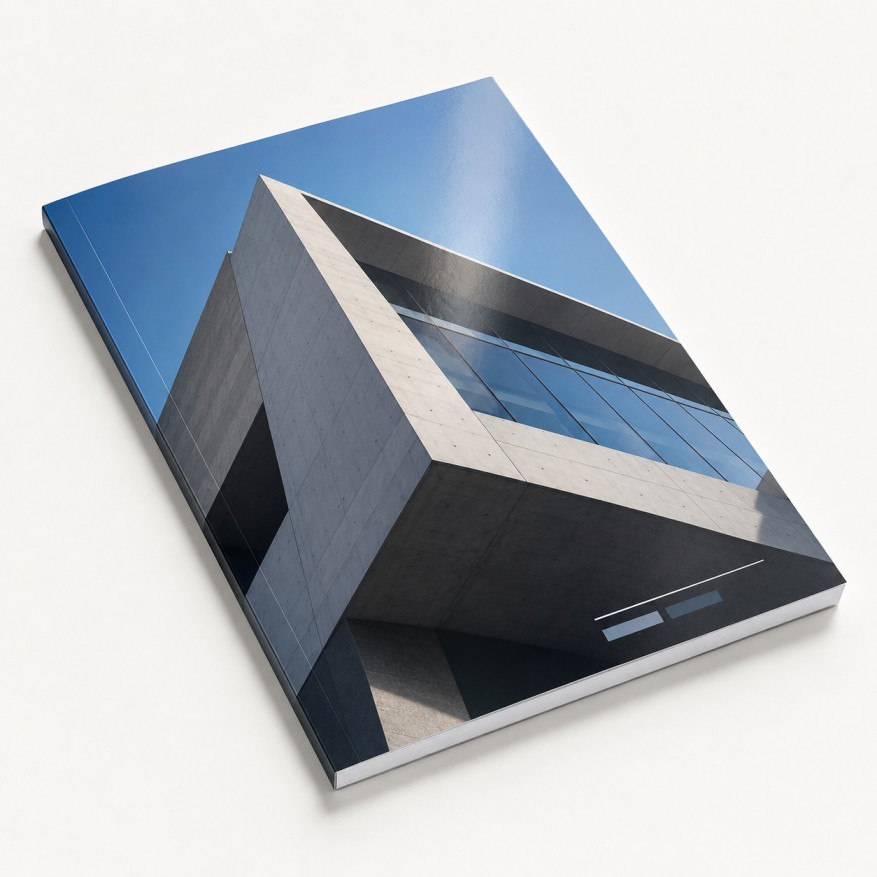
Architecture portfolio book printing typically calls for an 8.5" x 11" portrait or 11" x 8.5" landscape format - large enough to show floor plans, sections, and renders at a readable scale. Premium color on 80# or 100# coated paper reproduces renders and project photography accurately. Perfect bound is the most common choice for architecture portfolios, but spiral binding is worth considering if you regularly present spreads that need to lay completely flat.
- • Recommended: 8.5x11 or 11x8.5, perfect bound, 80# coated, premium color, 40-80 pages
- • Pro tip: Include project credits and technical details in smaller type below each project - reviewers look for these
Graphic Design Portfolio Book Printing
A graphic design portfolio printed book is a design project in itself. The layout, grid system, type hierarchy, and cover design all demonstrate your skills. 8.5" x 11" portrait is the standard, but 7" x 10" works well for a more compact, editorial-style presentation. Perfect bound or hardcover - hardcover if you want the portfolio to feel like a monograph rather than a lookbook.
- • Recommended: 8.5x11 or 7x10, perfect bound or hardcover, 80# coated, premium color, 40-60 pages
- • Pro tip: Use a matte laminated cover for a refined, studio-quality feel that stands out from glossy competitors
Photography Portfolio Book Printing
Photography portfolio book printing demands the best paper and color reproduction you can get. 100# glossy paper is the premium choice - it holds detail in shadows and highlights, saturates colors deeply, and gives photographs the weight they deserve. Landscape orientation (11" x 8.5") works naturally for landscape and editorial photography. For a premium option, see our coffee table book printing guide.
- • Recommended: 11x8.5 landscape or 8.5x11 portrait, perfect bound or hardcover, 100# glossy, premium color
- • Pro tip: Order a single proof to verify color accuracy before committing to a larger run - screens lie, paper doesn't
Art Portfolio Book Printing
Art portfolio book printing and artist portfolio book printing cover a wide range - paintings, illustrations, mixed media, sculpture documentation, digital art. The common thread is that color fidelity and paper texture matter. For painterly work, uncoated paper can complement the tactile quality of the original medium. For digital illustration and photography of 3D work, coated paper gives the sharpest reproduction.
- • Recommended: 8.5x11 portrait, perfect bound or hardcover, 80# coated or uncoated, premium color, 40-80 pages
- • Pro tip: Include dimensions and medium for each piece - gallery and residency reviewers expect this context
Portfolio Design Tips for Print
A well-designed portfolio layout makes the difference between a book that gets studied and one that gets skimmed. These guidelines apply across disciplines:
- Edit ruthlessly. 8-12 of your strongest projects is better than 25 mediocre ones. Reviewers remember quality, not volume. A 40-60 page portfolio is more effective than a 200-page catalog of everything you've ever done.
- Give images room to breathe. Generous margins and white space let each piece command attention. Don't crowd the page with tiny thumbnails - fewer images at a larger scale always reads better in print.
- Use a consistent grid. A clean grid system across every page makes the book feel designed and intentional, not just assembled. This is especially important for graphic design portfolios where the layout itself is being evaluated.
- Lead and close strong. Put your best project first and your second-best last. First impressions and final impressions are what interviewers remember most clearly.
- Design the cover. Your cover is the first thing a reviewer sees. A clean, typographic cover with your name and discipline reads as confident. Avoid cluttered cover designs - let the interior work speak for itself.
- Include contact information. Your name, email, website, and phone number should appear on the cover, title page, and back cover. Make it easy for someone to reach you after they've put the book down.
Frequently Asked Questions
How much does portfolio book printing cost?
A typical 60-page 8.5x11 perfect bound portfolio with premium color on 80# coated paper starts around $12-16 for a single copy and drops to $4-6 per copy at 500+ units. Use the calculator at the top for an exact quote based on your specs.
What is the best binding for a portfolio book?
Perfect binding is the most popular choice - clean spine, professional appearance, and it's what most reviewers expect. Hardcover is the premium option for portfolios that need to last. Spiral is best for architecture and design portfolios where spreads need to lay completely flat. See our perfect bound and hardcover pages for details.
What size should a portfolio book be?
8.5x11 inch portrait is the most common and recommended size. Large enough for professional-scale work, fits in standard bags, and is the format interviewers expect. 11x8.5 landscape works well for photography and architecture. All 11 trim sizes support every binding type.
Can I print just one portfolio book?
Yes. No minimums. Print a single portfolio book for an interview, client meeting, or proof review. Many designers start with one copy to verify quality, then come back for 5-25 copies at volume pricing.
What paper is best for a portfolio book?
80# coated is the most popular choice - great color, professional weight, good price. 100# glossy is the premium pick for photography portfolios. 80# uncoated gives a softer, more editorial feel that works well for fine art and illustration.
How do I print a portfolio book from a PDF?
Design your portfolio in InDesign, Illustrator, Canva, or any layout tool. Export as a print-ready PDF at 300 DPI in CMYK with 0.125" bleed. Upload to YourBookPress, configure your specs, and order. Our system checks your file automatically for resolution and dimension issues.
Can I print an architecture portfolio book?
Yes. Architecture portfolio book printing is one of our most common use cases. 8.5x11 portrait or 11x8.5 landscape, premium color on 80# or 100# coated paper, perfect bound or spiral. Upload your PDF with renders, plans, and project photography and we print it exactly as you designed it.
How long does portfolio book printing take?
Standard production is 5-7 business days after proof approval, plus 2-5 business days for shipping. Rush production (2-3 business days) is available at checkout for last-minute interviews and deadlines.